

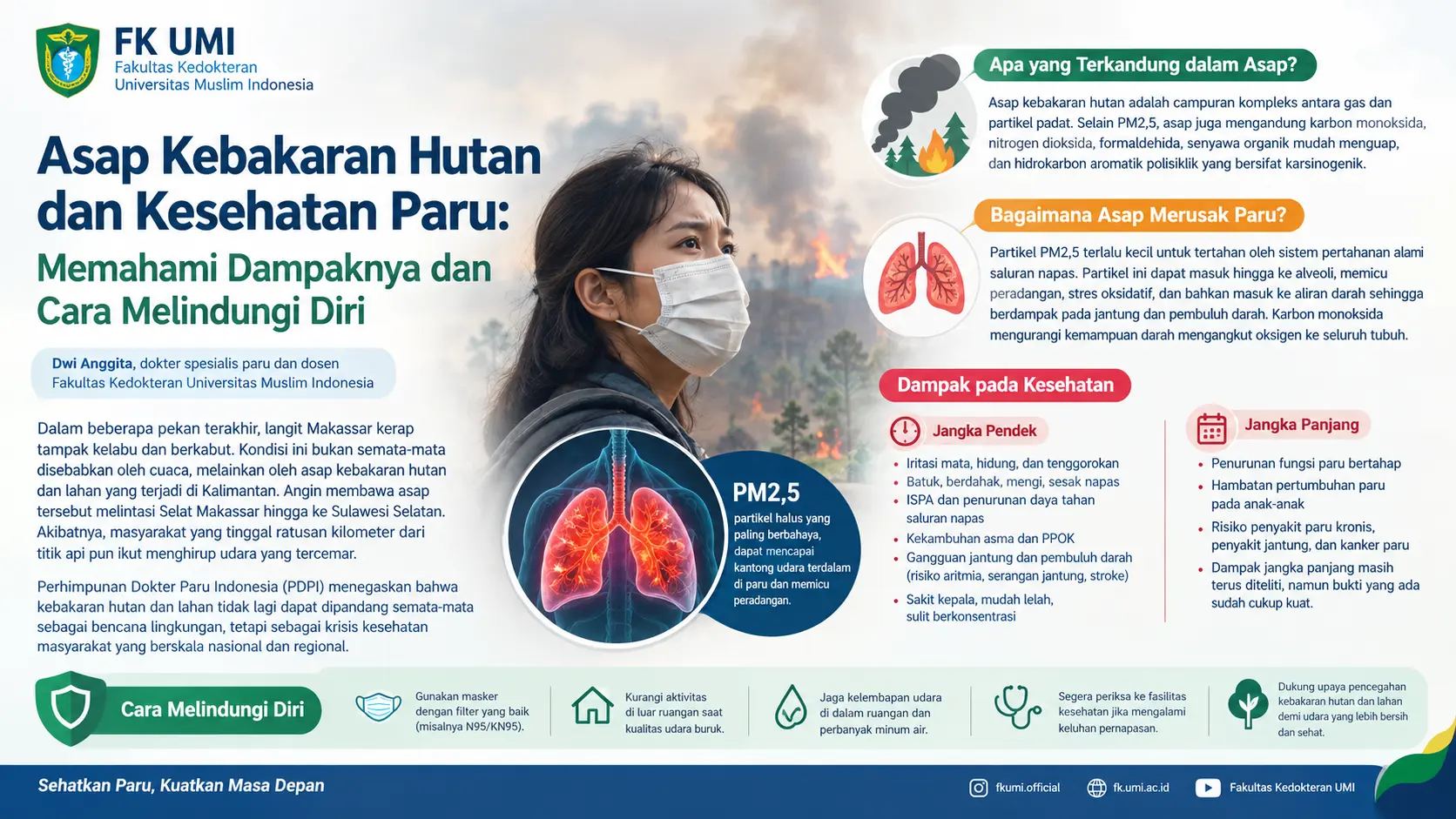
Makassar, UMI Faculty of Medicine — Haze caused by forest and land fires is a serious concern for public health. Its effects are felt not only by people living near the fire sites but can also reach areas hundreds of kilometers away. In Makassar and several areas of South Sulawesi, the gray and hazy air conditions may be caused by smoke from forest and land fires carried by the wind from Kalimantan.
Dr. Dwi Anggita, M.Kes., Sp.P, a pulmonologist and lecturer at the Faculty of Medicine, University of Muslim Indonesia (FK UMI), explains that forest fire smoke is a complex mixture of various gases and particles. One of the components that warrants the most caution is particulate matter measuring 2.5 micrometers or smaller (PM2.5).
PM2.5 particles are so small that they can bypass the respiratory tract’s natural defense system and penetrate all the way to the alveoli—the deepest part of the lungs responsible for the exchange of oxygen and carbon dioxide. Exposure to these particles can trigger inflammation and oxidative stress. In fact, some of these ultrafine particles can penetrate the alveolar walls and enter the bloodstream, potentially affecting the heart and blood vessels.
Causing Various Health Problems
Exposure to wildfire smoke can cause health complaints in a relatively short period of time. Symptoms that may appear include sore and watery eyes, a runny nose, an itchy or sore throat, coughing, phlegm, wheezing, a heavy feeling in the chest, and shortness of breath.
Poor air quality can also increase the risk of acute respiratory infections and exacerbate chronic conditions such as asthma and chronic obstructive pulmonary disease (COPD). Exposure to PM2.5 is also associated with an increased risk of heart and blood vessel disorders, particularly among the elderly.
Meanwhile, repeated long-term exposure can contribute to a decline in lung function. In children, exposure to air pollution is also associated with impaired lung growth that can persist into adulthood. The risk of chronic lung disease, heart disease, and lung cancer is also a concern with long-term exposure.
Vulnerable Groups Require Greater Attention
Not everyone faces the same level of risk. Infants and children, the elderly, pregnant women, and people with asthma, COPD, bronchiectasis, tuberculosis, and other lung diseases are among the groups most vulnerable to the effects of air pollution.
Risks also need to be considered for people with heart disease, hypertension, and diabetes; smokers; and those who work or spend a lot of time outdoors, such as motorcycle taxi drivers, parking attendants, street vendors, and sanitation workers.
Monitor Air Quality and Reduce Exposure
The public is advised to monitor air quality regularly using the Air Pollutant Standard Index (ISPU). When air quality falls into the “unhealthy” category, outdoor activities should be minimized, especially for vulnerable groups.
When you must be outdoors during periods of high pollution, the use of respirators such as N95 or KN95 masks is recommended because they provide better protection against PM2.5 particles than cloth masks or standard surgical masks. Masks must also be worn snugly to minimize gaps through which polluted air can enter.
Indoors, the public is advised to close doors and windows when smoke is thick. If possible, designate one room as a cleaner-air zone and use an air purifier with a HEPA filter. People should also avoid activities that increase indoor pollution, including smoking and burning items in enclosed spaces.
Recognize the Warning Signs
People should seek medical help immediately if they experience shortness of breath that does not improve, chest pain or tightness, blue lips or fingertips, a severe, persistent cough or coughing up blood, severe dizziness, weakness, or loss of consciousness.
In children, warning signs include very rapid breathing, the chest wall pulling inward during breathing, excessive fussiness, or refusal to breastfeed or eat.
Clean Air Is a Shared Responsibility
Forest fire smoke is not merely an environmental issue, but also a threat to lung health and overall well-being. The public can reduce risks by monitoring air quality, limiting exposure, wearing appropriate masks, and paying special attention to vulnerable family members.
Protective measures must also be accompanied by efforts to prevent forest and land fires. Avoiding open burning of trash or land and supporting various fire prevention initiatives are steps we can all take together.
Clean air is both our right and our shared responsibility.