
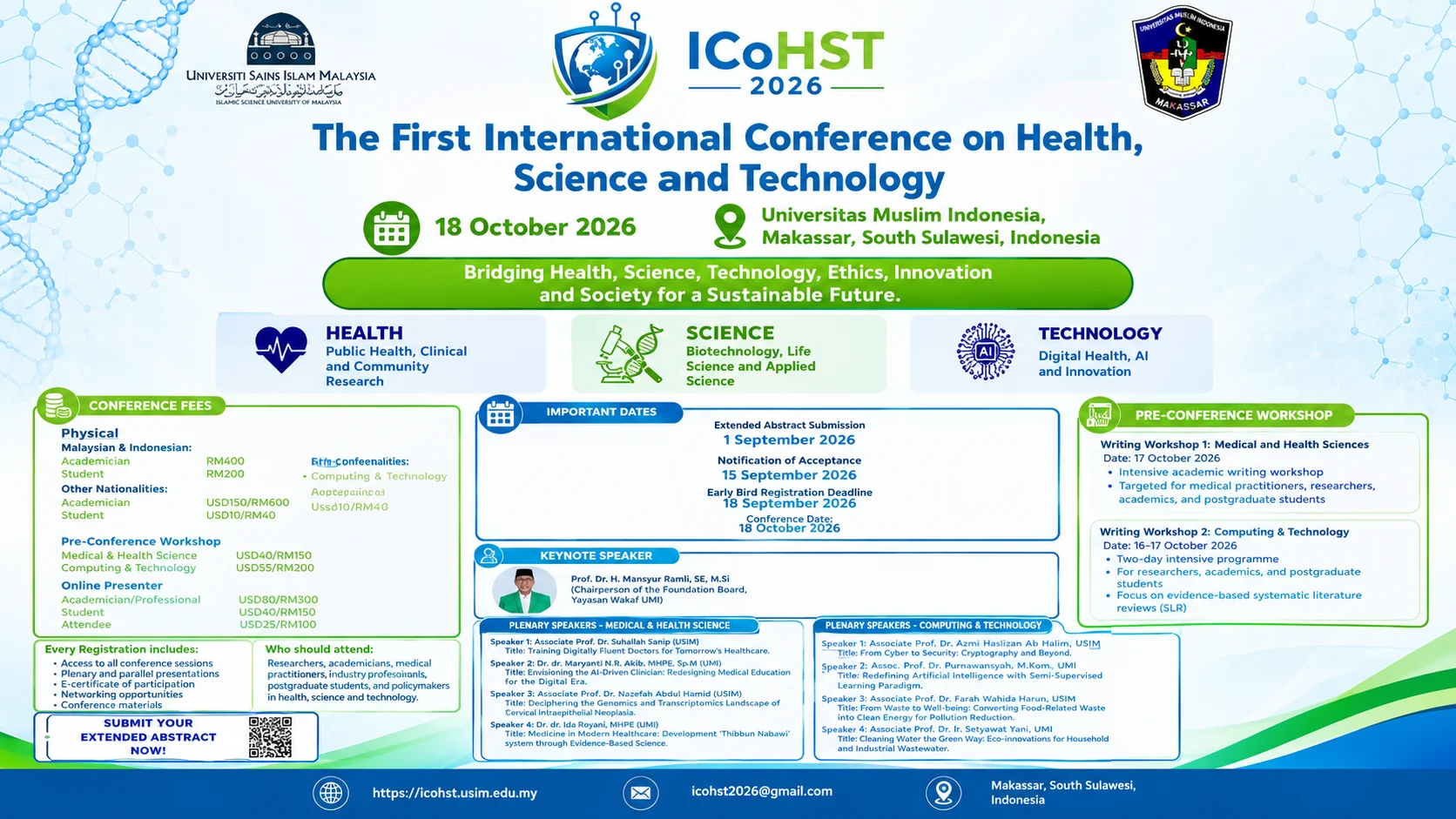
Makassar – The Faculty of Medicine at the Indonesian Muslim University (FK UMI) has been entrusted to serve as a co-host for The First International Conference on Health, Science, and Technology (ICoHST) 2026, which will take place on Sunday, October 18, 2026, at the University of Muslim Indonesia in Makassar, South Sulawesi. This involvement represents a strengthening of international collaboration in the development of interdisciplinary science, research, and innovation.
ICoHST 2026 will feature the theme “Synergizing Health, Science, and Technology: A Multidisciplinary Approach,” which emphasizes the importance of synergy between the fields of health, science, and technology through a multidisciplinary approach. The conference also embodies the spirit of “Bridging Health, Science, Technology, Ethics, Innovation, and Society for a Sustainable Future,” aiming to bridge health, science, technology, ethics, innovation, and society to realize a sustainable future.
This international conference brought together academics, researchers, and practitioners from the Indonesian Muslim University (UMI) and the Islamic Science University of Malaysia (USIM). Various scientific sessions were held to discuss the latest developments, share research findings, and expand opportunities for collaboration in the fields of medicine, health, computing, and technology.
The event began with opening remarks from the Dean of the UMI Faculty of Medicine, Dr. dr. H. Nasrudin Andi Mappaware, Sp.OG(K), followed by remarks from the Vice Rector of USIM, Professor Dato’ Ts. Dr. Sharifudin Md Shaarani. The Rector of UMI, Prof. Dr. H. Hambali Thalib, S.H., M.H., delivered the opening remarks as well as a keynote speech titled “Bridging Science, Technology, and Islamic Philanthropy: The Emerging Role of Waqf in Shaping a Sustainable Future.” The presentation highlighted the role of waqf in connecting advancements in science, technology, and Islamic philanthropy to support a sustainable future.
During the plenary session on medicine and health sciences, the conference featured several speakers from UMI and USIM. Associate Professor Dr. Suhaila Sanip from USIM presented on the topic “Training Digitally-Fluent Doctors for Tomorrow’s Healthcare,” while Dr. dr. Marlyanti N.R. Akib, M.Kes., Sp.M, MHPE, FFRI from UMI presented “Envisioning the AI-Driven Clinician: Redesigning Medical Education for the Digital Era.” Both topics highlighted the development of medical professionals’ competencies and the transformation of medical education in the digital age.
The health session also featured Prof. Dr. Norsham Juliana Nordin from USIM, who discussed the integration of artificial intelligence, precision medicine, and biological rhythms. From UMI, Dr. dr. M. Hamsah, M.Kes., Sp.OG discussed the use of smart health technologies to empower patients, while dr. Berry Erida Hasbi, Sp.B highlighted technological innovations to support recovery and the advancement of physical medicine services. In the subsequent plenary session, Associate Professor Dr. Nazefah Abdul Hamid from USIM discussed genomics and transcriptomics in cervical intraepithelial neoplasia, while Dr. Ida Royani, M.Kes., MHPE, FFRI from UMI presented the development of the Thibbun Nabawi system in modern healthcare through a scientifically evidence-based approach.
In addition to the health sector, the computing and technology session featured discussions on cybersecurity, artificial intelligence, digital transformation, and sustainable technology. Associate Professor Dr. Azni Haslizan Ab Halim from USIM presented on cryptography and cybersecurity, while Associate Professor Dr. Purnawansyah, M.Kom. from UMI presented on the development of artificial intelligence through a semi-supervised learning approach. Another speaker, Associate Professor Dr. Farida Hazwani Mohd Ridzuan from USIM, discussed cover selection in steganography, while Dr. Ramdan Satra, M.Kom., from UMI addressed the optimization of wireless sensor networks.
The conference also featured Associate Professor Dr. Ihwana Asad and Associate Professor Dr. Dolly Indra, M.M.SI., from UMI, who discussed the digital transformation of the halal ecosystem and the recognition of Indonesian Sign Language (BISINDO) through a computer vision approach. In the subsequent plenary session, Associate Professor Dr. Farah Wahida Harun from USIM presented on the conversion of food waste into clean energy, while Associate Professor Dr. Ir. Setyawati Yani from UMI discussed environmentally friendly innovations in the management of domestic and industrial wastewater.
The contribution of the UMI Faculty of Medicine was also evident through the participation of several faculty members as speakers in the symposium sessions. Dr. dr. Nasrudin Andi Mappaware, Sp.OG, Subsp. Obginsos presented on “Transforming Women’s Healthcare: Integrating Reproductive Medicine, Quality of Care, and Health System Innovation.” Meanwhile, Dr. Irna Diyana Kartika, Ph.D., Sp.PK., presented on the topic “The Lab of Tomorrow: Harnessing Companion Diagnostics for Targeted Therapies.” Both topics highlight a focus on innovation in women’s healthcare services, improving the quality of care, and developing diagnostics to support more targeted therapies.
In addition to the health sessions, speakers from UMI and USIM in the field of technology also discussed molecular innovations, bioinformatics, data analysis, engineering to support the elderly population, and the strengthening of sustainable food supply chains. This diverse range of topics highlights the broad scope of ICoHST 2026 and the importance of interdisciplinary collaboration in addressing societal challenges.
During the event, the sessions on medicine and health sciences were moderated by Dr. Muhammad Wirawan Harahap, Sp.An-TI, FISQua, AIFO-K, while the subsequent plenary session was moderated by Dr. Rachmat Faisal Syamsu, M.Kes. In addition to the plenary presentations and symposiums, the conference program also included parallel oral presentations, Q&A sessions, and the presentation of the Best Paper Award.
The trust placed in the UMI Faculty of Medicine as a co-host of ICoHST 2026 presents a strategic opportunity to strengthen international academic networks, enhance knowledge exchange, and expand research collaboration with partner institutions. This event also supports the development of medical education that is adaptive to technological advancements, grounded in ethics, and oriented toward the needs of society.
Through the hosting of ICoHST 2026, the UMI Faculty of Medicine, together with UMI and USIM, is expected to continue strengthening collaboration in the fields of education, research, and innovation. The synergy between health, science, and technology is a crucial step toward fostering scientific solutions that benefit society and support sustainable development at both the national and international levels.