
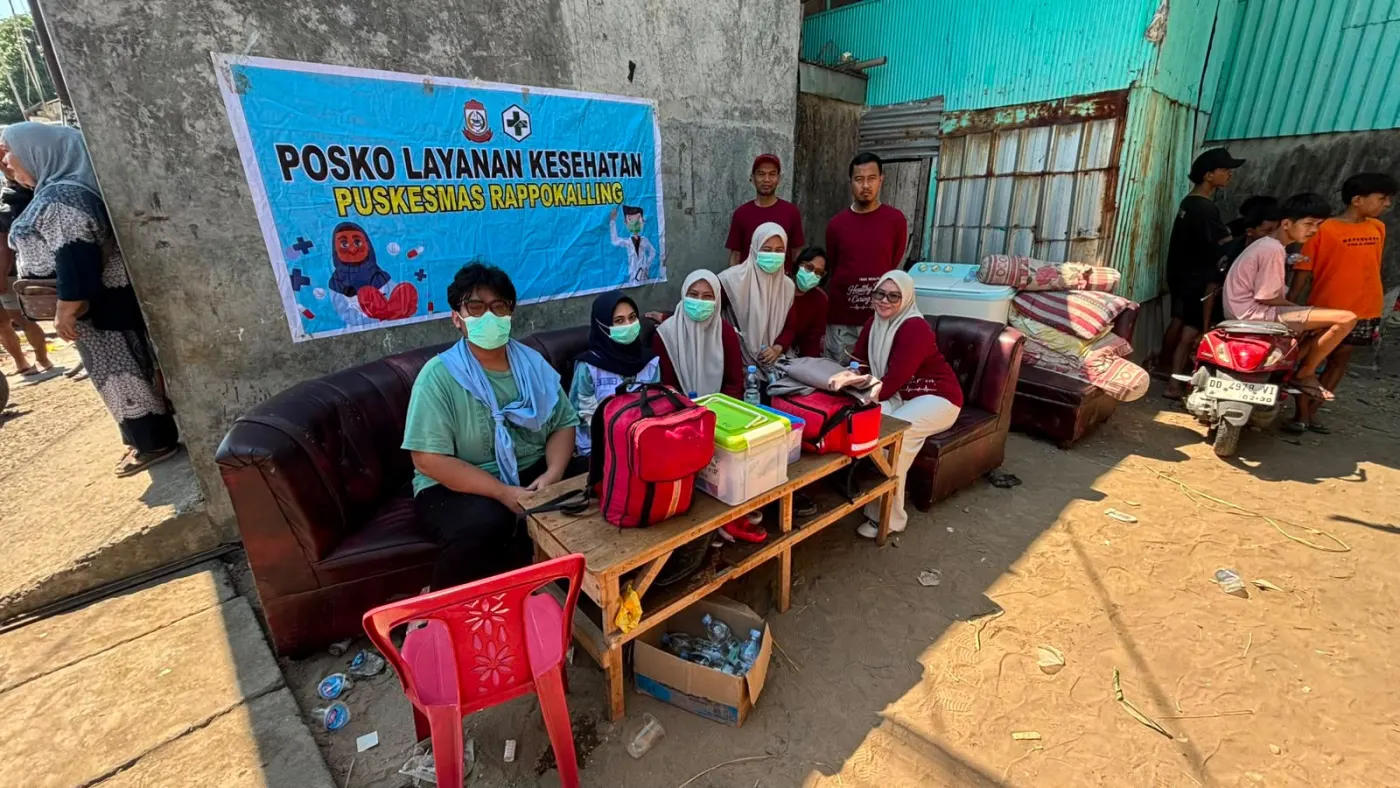
Makassar – The Rapid Response Team (TRC) of the 110 Medical Assistance Team (TBM) at the Faculty of Medicine, Indonesian Muslim University (FK UMI), moved quickly to provide health services to residents affected by a fire on Sultan Abdullah II Street, Tallo District, Makassar City, on Friday (July 31, 2026).
The fire, which broke out around 1:30 a.m. WITA, destroyed approximately 50 homes and left dozens of families homeless. As a gesture of concern for the community, the FK UMI TBM 110 Rapid Response Team (TRC) was immediately deployed to the scene to provide emergency health services to the victims.
In carrying out this humanitarian effort, the TRC TBM 110 FK UMI collaborated with the Rappokalling Community Health Center, elements of the Indonesian National Armed Forces (TNI) and the Indonesian National Police (Polri), as well as the Makassar City Fire Department, to establish an Emergency Health Services Command Post. The post provided medical care to victims suffering from various health complaints and injuries resulting from the fire.
The medical team treated a number of cases found on-site, including puncture wounds (vulnus punctum), burns (combustio), and abrasions (vulnus excoriatum). Treatment included cleaning wounds, suturing, administering medication as indicated, and follow-up observation to prevent infection and complications.
The Rector of the University of Muslim Indonesia, Prof. Dr. H. Hambali Thalib, S.H., M.H., expressed his appreciation for the swift response shown by UMI Faculty of Medicine students in assisting the disaster-affected community. According to him, the academic community’s involvement in humanitarian efforts is a tangible manifestation of the values championed by the University of Muslim Indonesia.
“When disaster strikes, the campus must not merely be a place of learning. It must be the first to arrive, bringing hope. Knowledge finds its true meaning when it is able to alleviate suffering, strengthen the vulnerable, and provide solutions for the community,” said Prof. Hambali.
He added that student involvement in humanitarian efforts embodies the UMI’s Catur Dharma—which integrates education, research, community service, and a commitment to UMI’s values and character education in real life.
Meanwhile, the Dean of the UMI Faculty of Medicine, Dr. dr. H. Nasrudin AM, Sp.OG(K)., Subsp.Obginsos., MARS., M.Sc., FISQua., AIFO-K., expressed his appreciation to all members of the UMI Faculty of Medicine’s TBM 110 TRC, who once again demonstrated their dedication, professionalism, and spirit of service to the community.
According to him, every humanitarian assignment serves as a real-world learning experience for medical students to integrate clinical competencies with the values of empathy and social compassion.
“TBM 110 is a true learning environment. This is where students learn that being a doctor is not just about the ability to diagnose diseases, but also about the ability to offer comfort, reassure grieving families, and be there when the community needs help,” he said.
He also emphasized that the motto “Dedicatio Pro Humanitate” is not merely a slogan, but a commitment that is continually put into practice through various humanitarian actions carried out by TBM 110 at the UMI Faculty of Medicine.
This activity is one form of community service consistently carried out by the UMI Faculty of Medicine. Through students’ active involvement in disaster response, the UMI Faculty of Medicine not only equips students with academic competencies and clinical skills but also instills the values of professionalism, social responsibility, and accountability as future doctors.
The humanitarian efforts carried out by the UMI Faculty of Medicine’s TBM 110 TRC once again reaffirm the commitment of the University of Muslim Indonesia’s Faculty of Medicine to producing outstanding, professional doctors who possess social sensitivity. In line with the University of Muslim Indonesia’s vision as a “Campus of Knowledge and Worship,” this initiative is expected to continue inspiring the academic community to make tangible contributions toward improving public health through a spirit of service and humanity.