
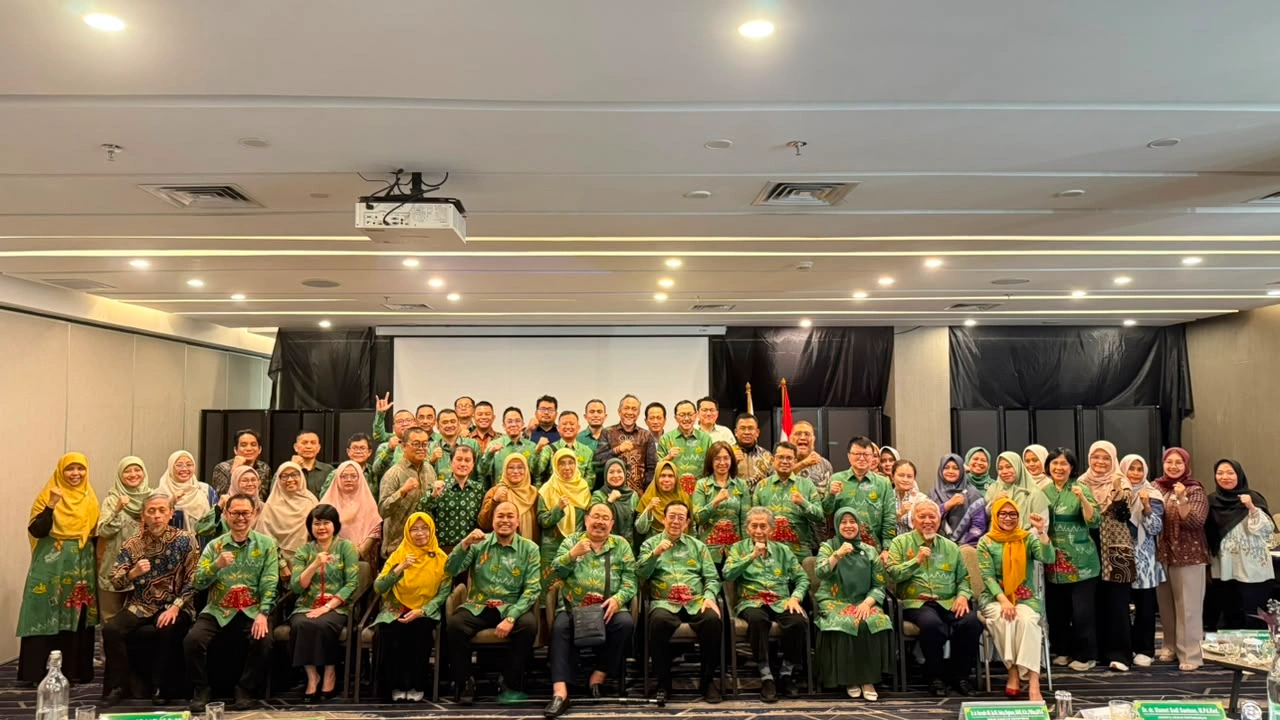
Jakarta, July 16, 2026 – The Association of Indonesian Private Medical Schools (AFKSI) held the 2026 AFKSI Deans’ Forum at the Novotel Cikini in Jakarta, attended by 75 deans and associate deans of private medical schools from across Indonesia. This annual forum serves as a strategic platform for the leadership of private medical faculties to strengthen collaboration, evaluate the development of national medical education, and formulate the organization’s policy direction in addressing the challenges of higher education in health sciences in Indonesia.
The event was officially opened by the Chair of the AFKSI Executive Board, Dr. dr. Nasrudin AM, Sp.OG(K), M.Sc., who is also the Dean of the Faculty of Medicine at the University of Muslim Indonesia (FK UMI). In his remarks, he emphasized that private medical faculties play an increasingly significant role in producing high-quality, innovative healthcare professionals capable of meeting both national and global healthcare needs. Inter-institutional collaboration is key to accelerating improvements in the quality of education, research, community service, and the governance of medical faculties that are internationally competitive.
This year’s forum featured the theme:
“Transformation and Collaboration of Private Medical Schools in Strengthening the Three Pillars of Higher Education to Realize Excellent, Impactful, and Sustainable Institutions.”
This theme reflects AFKSI’s commitment to strengthening the transformation of medical education through innovation, national and international collaboration, and reinforcing the three pillars of higher education as the primary foundation for building outstanding medical education institutions.
The event began with a Plenary Session featuring Prof. Dr. med. dr. Tri Hanggono Achmad, an Expert Advisor to the Ministry of Higher Education, Science, and Technology of the Republic of Indonesia, as the keynote speaker. The scientific session was moderated by Prof. Dr. dr. Suryani, M.Kes., Sp.GK(K), Chair of the AFKSI Expert Council and Dean of the Faculty of Medicine at Muhammadiyah University of Makassar.
In his presentation, Prof. Tri Hanggono Achmad emphasized the importance of transforming medical education to adapt to advancements in science, technology, digitalization, artificial intelligence, and the needs of the national health system. Medical schools—including private medical schools, which are more numerous—are encouraged to continue improving the quality of their governance, expanding collaborative networks, strengthening a culture of research and innovation, and producing graduates with global competencies without compromising national values and professionalism.
Following the plenary session, the event continued with the AFKSI Organizational Meeting, which was divided into four committees, namely:
the Education Committee; the Research Committee; the Community Service Committee; and the Cooperation Commission.
Each commission discussed the organization’s strategic programs and formulated recommendations that will serve as guidelines for the implementation of AFKSI programs in the coming period.
The forum also featured a presentation on the history of AFKSI, highlighting the organization’s development over more than five decades. The organization began as the Council of Deans of Private Medical Schools throughout Indonesia (MPFKS) in 1971, then underwent several name changes until, at the 17th National Congress in 2011, it officially became the Association of Private Medical Faculties of Indonesia (AFKSI) as an adaptation to developments in global medical education. Subsequently, at the 19th National Congress held at Warmadewa University in Bali, AFKSI obtained legal entity status pursuant to Decree of the Minister of Law and Human Rights No. AHU.0003019.AH.01.07 of 2017.
The forum also presented the current state of private medical education in Indonesia. Currently, AFKSI has 75 member medical faculties, with 32 faculties (42%) having received “Excellent” accreditation status. The distribution of members spans six regions in Indonesia, indicating increasingly equitable development in the quality of private medical education institutions.
In addition, the national trend in the number of medical schools was presented. Prior to the moratorium, there were 92 medical schools, whereas after the moratorium, that number increased to 138 medical schools, consisting of 85 medical schools at private universities (62%) and 53 medical schools at public universities. These data demonstrate the significant contribution of private universities to the delivery of medical education in Indonesia.
One important achievement highlighted by the forum was the expansion of Specialist Medical Education Programs (PSPDS) at private medical schools. To date, 19 private medical schools have established 47 specialist programs, representing approximately 25.3% of all private medical schools. Several institutions have entered the independent phase, including the Faculty of Medicine at Pelita Harapan University (UPH), the Faculty of Medicine at YARSI University, the Faculty of Medicine at Prima Indonesia University, the Faculty of Medicine at the Indonesian Muslim University (UMI), and the Faculty of Medicine at Hang Tuah University. In addition, there are a number of faculties currently participating in an accelerated program to launch Specialized Medical Study Programs (PSPS), including several Muhammadiyah medical faculties, the University of Islam Indonesia, Jenderal Achmad Yani University, Sultan Agung Islamic University, Atma Jaya Catholic University, Ciputra University, Maranatha Christian University, Batam University, and other institutions.
The forum also discussed various strategic AFKSI programs currently underway or planned for the future, including institutional capacity building toward excellent accreditation and international accreditation; the launch of medical specialist, master’s, and doctoral programs; strengthening faculty governance; the formation of an Ad Hoc Team for Medical Professional Education; strengthening the Medical Education Expert Team in the areas of curriculum and assessment; the development of collaborative research, community service, and joint scientific publications; expanding national and international cooperation through the renewal of Memoranda of Understanding (MoUs) on the Tridarma of Higher Education; and strengthening the consortium for the development of Specialist Medical Education Study Programs within AFKSI.
Through the 2026 AFKSI Deans’ Forum, it is hoped that stronger synergy will be built among private medical faculties in Indonesia to improve the quality of education, strengthen research and community service, develop modern institutional governance, and expand national and international collaboration. All recommendations resulting from the committee sessions will serve as the basis for the formulation of AFKSI’s work program in support of the transformation of Indonesian medical education toward institutions that are excellent, impactful, adaptive, and sustainable.