
Makassar, August 29, 2025 – The Faculty of Medicine (FK) at the Indonesian Muslim University (UMI)
demonstrated its commitment to public health through a Community
Service (PkM) initiative titled “Raising Awareness and Promoting Early Detection of Noncommunicable Diseases (NCDs)
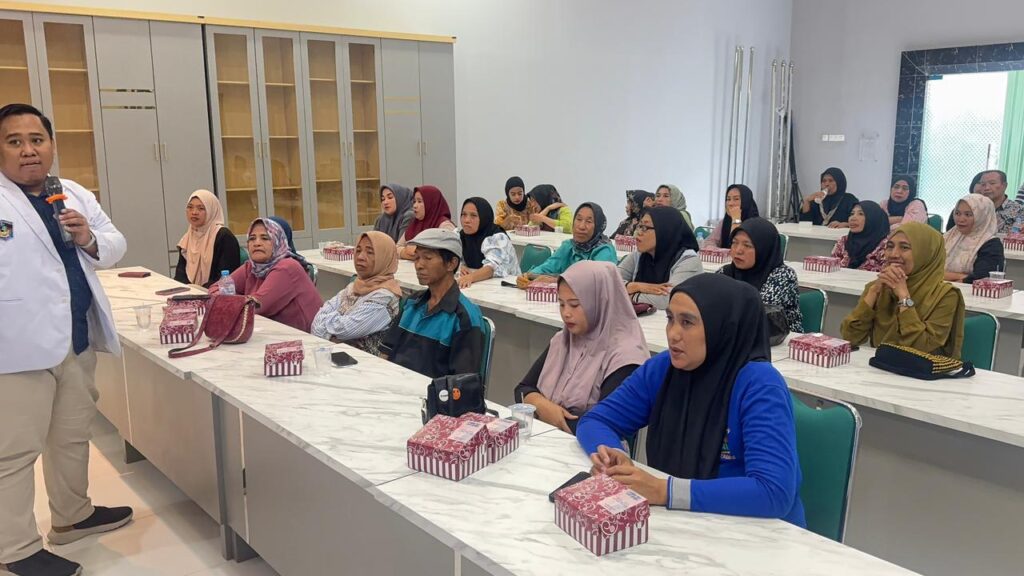
through Education and Health Screening for Sanitation Workers.” Led by Dr. Sigit Dwi
Pramono, M.Biomed, the event successfully reached 36 sanitation workers from PT. Bisri and
was held in Meeting Room GB 101 on the 1st floor of the UMI Faculty of Medicine.
Noncommunicable diseases (NCDs) such as hypertension, diabetes mellitus, and obesity continue to pose
a serious threat to public health, including in the workplace. Janitorial staff, who
play a vital role in maintaining the cleanliness of campus facilities, often face overlooked health risks
due to a lack of access to information and routine screening services. This
situation is exacerbated by the scarcity of preventive health education programs specifically tailored to this group of non-academic workers
.
To address these issues, the UMI Faculty of Medicine’s Community Service (PkM) team—which also included Dr. Berry Erida Hasbi, Sp.B;
Suci Noviyanah Ansary, S.Farm., M.Pharm.Sci, as well as two medical students,
conducted an interactive educational session on NCDs and the importance of a healthy lifestyle. This
educational session was supported by audiovisual materials and small-group discussions to ensure the information
was conveyed effectively and was easily understood by the participants.
In addition to the educational component, the event also included free health screenings, such as blood pressure
, blood sugar, weight, height, and waist circumference measurements. Early detection is crucial for
identifying high-risk individuals and providing necessary
medical follow-up recommendations, so that treatment can be initiated earlier to prevent more
serious complications.
Dr. Sigit Dwi Pramono, M.Biomed, as the Executive Chair, stated, “We hope this event
will not only increase sanitation workers’ knowledge and awareness of NCDs but
also empower them to take preventive steps to manage their
own health. This is a tangible manifestation of the UMI Faculty of Medicine’s commitment to fulfilling the Tri Dharma of Higher Education,
particularly in the area of sustainable community service grounded in real-world needs.”
The active participation of 36 sanitation workers from PT. Bisri demonstrated high enthusiasm for
this initiative. It is hoped that through programs like this, the quality of life and health of these sanitation heroes
within the UMI community will continue to improve, in line with UMI’s vision to make
a positive contribution to society at large. This activity also serves as a foundation for the development
of similar health programs in the future, strengthening communication networks between the academic community
and all campus support staff.